Unveiling the Khmer Wedding Dress History: From Angkorian Gold to the Thai Soap Opera Sabai
Unveiling the Khmer Wedding Dress History: From Angkorian Gold to the Image Rewritten by Thai Dramas
If we step into the shoes of someone who loves observing details or a media consumer who has witnessed countless shifts in art trends, and focus on the story of the "Cambodian wedding dress," we will see a fascinatingly volatile graph. It's a timeline that runs from magnificent historical roots, leaps across time into an era of hybridization, and ends up as a severe "pop culture" phenomenon capable of overwriting history in the beliefs of modern society.
The Angkor Era: When Grandeur Meant "Gold Jewelry," Not Clothes
If we open the history books and refer to empirical evidence like the bas-reliefs at Angkor Wat or Bayon, the attire of the ancient Khmer people was designed for an extreme tropical climate. Both high-ranking men and women wore a long piece of cloth called a "Sampot," draped in various ways—either left hanging or rolled and tucked at the back, similar to a Chong Kben (dhoti).
But here is the peak: the upper bodies of ancient Khmer women were mostly "bare" or perhaps covered only by a small strip of cloth loosely tied across the chest. What denoted rank and grandeur in auspicious ceremonies wasn't flowing draped fabrics, but "metal jewelry."
Imagine bronze and gold, ornate necklaces, crowns, armbands, bracelets, and intricately carved belts worn directly over the body. The fashion of this era highlighted the physique, combined with the fierce and commanding presence of metallurgy. This was a highly powerful signature of the ancient Khmer Empire.
The Transitional Era (1950s - 1990s): Sampot, Bouffant Hair, and Lace Blouses
Before the trend shifted entirely towards the Thai-style Sabai, Cambodia had a period where their fashion was highly distinct, especially during the 60s and 70s (pre-Khmer Rouge). This was an era that embraced Western influence mixed with traditional roots.
If we dig through old wedding photos of Cambodians from that era, we see brides wearing the "Sampot Chong Kben." For the upper body, they wore high-necked, long-sleeved, or boat-neck blouses tailored from fluffy lace. Their hair was styled in a high bouffant, following the French and Western fashion of the time.
Even moving into the 90s, the visual memory of a Khmer wedding still revolved around lace blouses and the Sampot. It was a classic, dignified look for the modern Khmer. Most importantly, there was virtually no appearance of the "sheer pleated Sabai" in any wedding photographs from that era.
Screen Influence: When Thai Period Dramas Changed Tastes
The crucial turning point that began to distort the historical timeline occurred when cross-border entertainment media operated at full capacity. Thai period television dramas—such as Sai Lohit, Tawipob, and the phenomenal hit Buppesannivas (Love Destiny)—penetrated the market and overwhelmingly captured the hearts of Cambodian viewers.
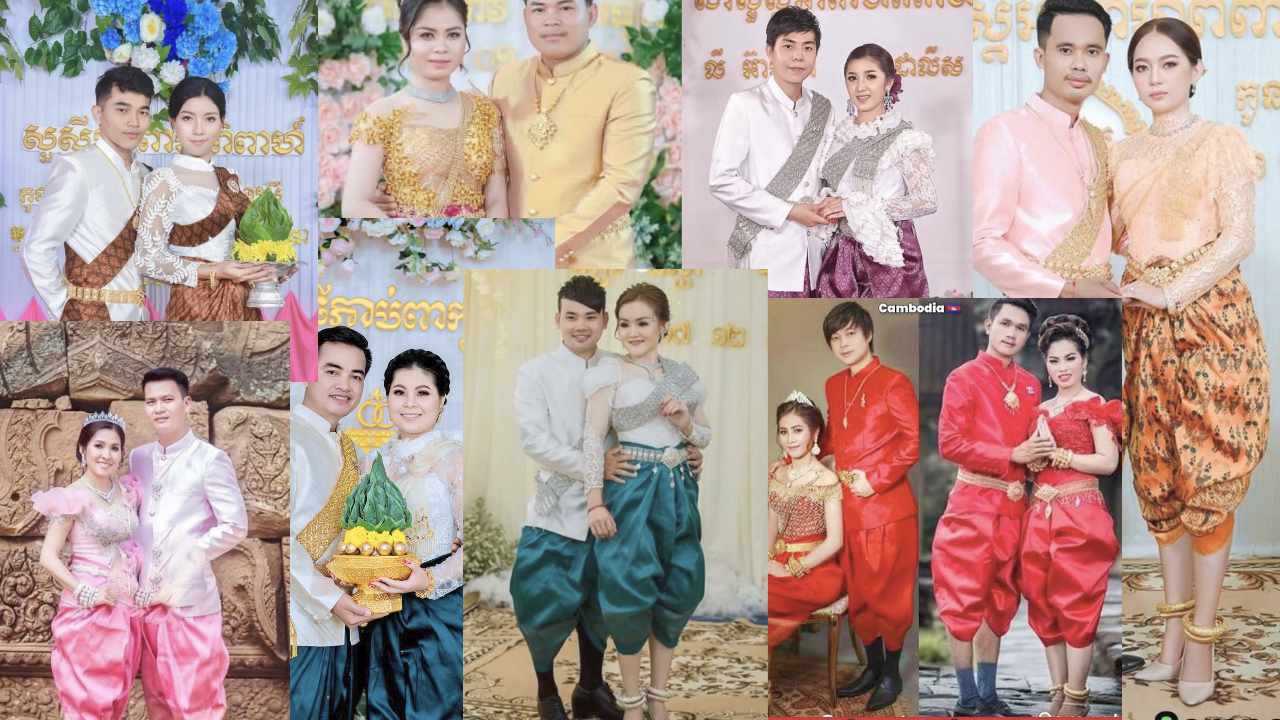
The traditional image of "ancient beauty" was replaced by the image of soap opera heroines wearing a form-fitting, flowing "pleated Sabai" and delicate silk tube skirts. Wedding studios in Cambodia were among the first to catch this trend. They began importing, modifying, and tailoring wedding dresses that almost 100% replicated the "Thai diagonal Sabai" to serve their clients. It was beautiful, romantic, and made the brides look exactly like the TV heroines they adored.
From Obsession to "Mass Illusion"
When the flowing Thai-style Sabai became the new standard for weddings across Cambodia, coupled with the growth of social media and extreme nationalism, a phenomenon akin to "mass hypnosis" began.
The new generation and many people who grew up with these modern pre-wedding photos chose to ignore their own historical evidence. They started comparing modern wedding photos with distorted interpretations of stone bas-reliefs to create a new narrative: "The flowing pleated Sabai and this dress silhouette are the ancient inheritance of the Khmer Empire." Anyone wearing this outfit was allegedly preserving traditional culture.
This is despite the fact that if they looked back at their own grandparents' wedding photos from the 60s to the 90s, they were still wearing lace blouses and Chong Kben. Or, if they traced it back to the true core of the Angkor era, their beauty was raw, bare, and glowing with metalwork—not the delicate draping of Chao Phraya river basin textiles worn today.
This is a case study proving that when soft power collides with commercial business and is coated in unchecked beliefs, historical truth can easily be replaced by "screen illusions." As a result, people collectively believe in a newly fabricated reality, sadly rejecting their own true roots in the process.